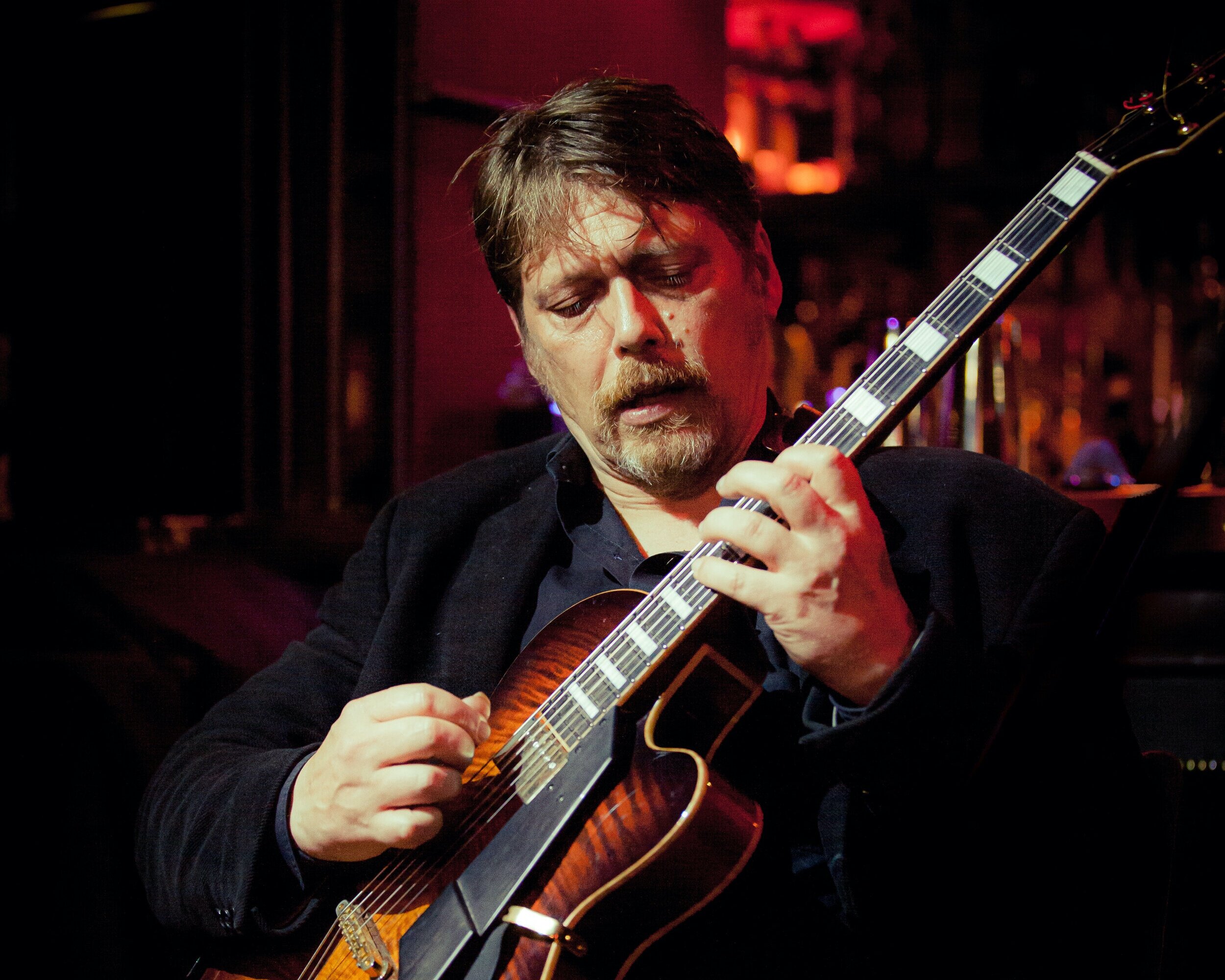
Position Playing
Position Playing is a practical system for taking your scales and arpeggios off autopilot, restricting your playing to small groups of frets so you build precise, confident note choices you can carry into real jazz standards.
-
-
Pt. 1
Restrict your playing to one area of the neck and shift key within it to fix shaky scale and arpeggio habits. You'll learn to avoid the weak notes that trip up major, minor and sus sounds.
Restrict your playing to one area of the neck and shift key within it to fix shaky scale and arpeggio habits. You'll learn to avoid the weak notes that trip up major, minor and sus sounds.
-
Pt. 2
Learn the core exercise: stay on one scale until the chord changes, then jump to the nearest note of the next. Working through A major and D minor in frets one to five builds the instinct for landing precisely under pressure.
Learn the core exercise: stay on one scale until the chord changes, then jump to the nearest note of the next. Working through A major and D minor in frets one to five builds the instinct for landing precisely under pressure.
-
Pt. 3
The same next available note approach applied to arpeggios, using A major 7 and D minor 7 in frets one to five. These wider jumps become natural springboard notes for launching a phrase with total confidence.
The same next available note approach applied to arpeggios, using A major 7 and D minor 7 in frets one to five. These wider jumps become natural springboard notes for launching a phrase with total confidence.
-
Pt. 4
All four core arpeggio types (major 7, minor 7, dominant 7, minor 7 flat 5) cycled through every key in fourths. The exercise is then applied against real chord changes to show it working in a tune.
All four core arpeggio types (major 7, minor 7, dominant 7, minor 7 flat 5) cycled through every key in fourths. The exercise is then applied against real chord changes to show it working in a tune.
-
Pt. 5
The remaining arpeggio types get the same treatment, with extra focus on minor 7 flat 5, the shape most guitarists find hardest. Practising it alongside the chords helps it properly settle in.
The remaining arpeggio types get the same treatment, with extra focus on minor 7 flat 5, the shape most guitarists find hardest. Practising it alongside the chords helps it properly settle in.
-
Pt. 6
Minor 7 flat 5 arpeggios stripped back to a single note per chord, sharpening your ear for the next interval. Includes a benchmark for moving on, plus a real playing example over backing tracks.
Minor 7 flat 5 arpeggios stripped back to a single note per chord, sharpening your ear for the next interval. Includes a benchmark for moving on, plus a real playing example over backing tracks.
-
-
-
Pt. 1
Move the whole exercise up to frets 8 to 12, with the logic behind why this jump makes more sense than inching up fret by fret.
Move the whole exercise up to frets 8 to 12, with the logic behind why this jump makes more sense than inching up fret by fret.
-
Pt. 2
Working through minor 7 arpeggios over random chord changes, only the first interval is called out each time, letting your fingers fill in the rest instinctively.
Working through minor 7 arpeggios over random chord changes, only the first interval is called out each time, letting your fingers fill in the rest instinctively.
-
Pt. 3
Introduces melodic minor and minor major arpeggios in frets 5 to 9, laying the groundwork for the altered dominant sounds needed to actually play over jazz standards.
Introduces melodic minor and minor major arpeggios in frets 5 to 9, laying the groundwork for the altered dominant sounds needed to actually play over jazz standards.
-
Pt. 4
Adds flat 9 and sharp 5 to the dominant 7 arpeggio, cycling through every key to hear how each alteration changes the sound and where it resolves.
Adds flat 9 and sharp 5 to the dominant 7 arpeggio, cycling through every key to hear how each alteration changes the sound and where it resolves.
-
Pt. 5
Introduces the diminished arpeggio, showing how its repeating minor third structure means several chords you'd expect to be different actually share exactly the same notes.
Introduces the diminished arpeggio, showing how its repeating minor third structure means several chords you'd expect to be different actually share exactly the same notes.
-
-
-
Pt. 1
All the arpeggios you've built get applied to a real jazz standard, All the Things You Are, working through every chord in frets 3 to 7 from lowest note to highest and back.
All the arpeggios you've built get applied to a real jazz standard, All the Things You Are, working through every chord in frets 3 to 7 from lowest note to highest and back.
-
Pt. 2
The full run through All the Things You Are, four notes on each arpeggio, changing to the next available note as the chords move, played first with each interval called out and then straight through with no talking.
The full run through All the Things You Are, four notes on each arpeggio, changing to the next available note as the chords move, played first with each interval called out and then straight through with no talking.
-
Pt. 3
Reassurance that struggling with the pace is completely normal, then a slower look at how these same intervals already contain the seeds of real bebop phrasing.
Reassurance that struggling with the pace is completely normal, then a slower look at how these same intervals already contain the seeds of real bebop phrasing.
-
Pt. 4
Playing along with a live band at 90 BPM, all still within frets three to seven, before finishing with a free-ranging solo across the whole neck to show the exercise's real payoff.
Playing along with a live band at 90 BPM, all still within frets three to seven, before finishing with a free-ranging solo across the whole neck to show the exercise's real payoff.
-
-
-
Pt. 1
Working through Body and Soul chord by chord, letting the tune itself reveal which alterations actually fit rather than imposing a fixed formula on every dominant chord.
Working through Body and Soul chord by chord, letting the tune itself reveal which alterations actually fit rather than imposing a fixed formula on every dominant chord.
-
Pt. 3
A walk through Stella by Starlight confirms the same patterns already spotted in Body and Soul and Autumn Leaves, with a few standout melody note choices worth learning on their own merit.
A walk through Stella by Starlight confirms the same patterns already spotted in Body and Soul and Autumn Leaves, with a few standout melody note choices worth learning on their own merit.
-
Pt. 4
Applying every insight from the tune analysis, Body and Soul gets played through in frets 5 to 9, working in the seven sharp 11, the flat 13, and the natural four on minor 7 flat 5 chords.
Applying every insight from the tune analysis, Body and Soul gets played through in frets 5 to 9, working in the seven sharp 11, the flat 13, and the natural four on minor 7 flat 5 chords.
-
Pt. 5
A repeat run through Body and Soul with half the notes per chord to suit the band's feel, followed by a closing free solo over the tune with the intervals indicated as they happen.
A repeat run through Body and Soul with half the notes per chord to suit the band's feel, followed by a closing free solo over the tune with the intervals indicated as they happen.
-
What You'll Learn
Build ConfidenceWorking within one small group of frets at a time means you always know exactly where you are, and that certainty builds real, lasting confidence in your playing.
Learn New ApproachesBy restricting your choices and moving to the next available note, you'll learn to hear harmony differently and find that some of your favourite jazz phrases were hiding in the exercise all along.
Gain Practical ToolsFrom scales and arpeggios to altered dominants and real standards like All the Things You Are, Body and Soul, and Stella by Starlight, each lesson gives you something you can take straight into your own playing.